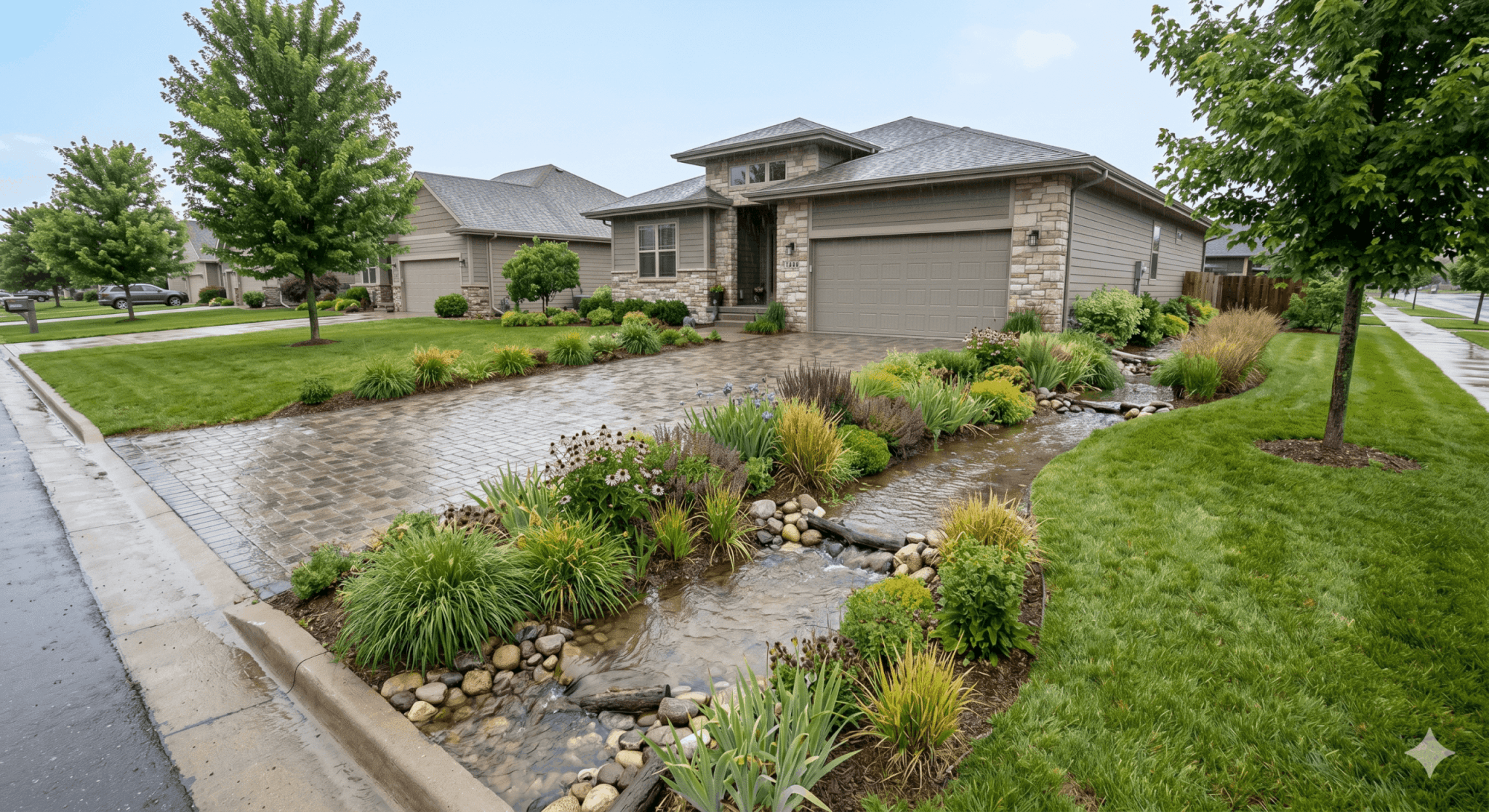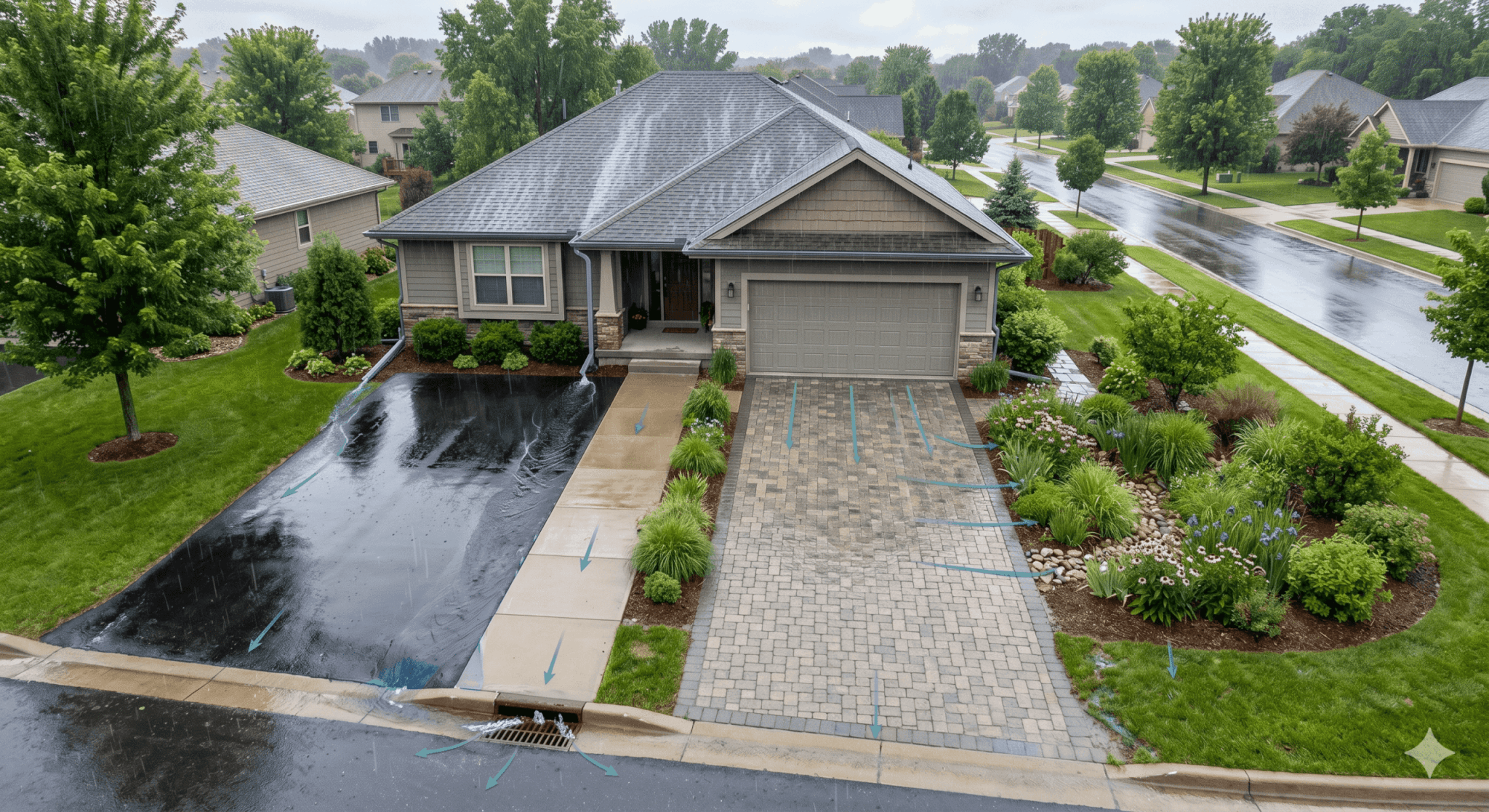


Most pricing guides for permeable pavers throw out a number and call it a day. You’ll see ranges like $10 to $30 per square foot, with little explanation of why two similar driveways can produce quotes that differ by thousands of dollars. That gap isn’t random. It comes down to what’s happening below the surface, and most guides skip right over it.
Permeable pavers cost more than just the materials. The stone reservoir underneath, the excavation depth, your soil’s ability to absorb water, and whether your site needs underdrains all shape the final number on a contractor’s quote. Understanding those variables keeps your budget realistic and prevents frustrating surprises.
This guide covers installed cost ranges by material type, a breakdown of what drives price differences across properties, real project totals for common applications like driveways and patios, and how local rebates or stormwater incentives can reduce what you actually pay out of pocket. If you want to know what permeable pavers will realistically cost for your property (not just a national average), keep reading.
Quick answer: Permeable pavers cost $8–$12 per square foot installed for concrete options and $15–$25 for natural stone — roughly $3–$5 more than standard concrete. That premium typically pays back in 5–10 years through stormwater utility fee credits of $5–$25 per month. Most cities with stormwater fee programs offer rebates specifically for permeable driveways and patios.
Key takeaways
- Permeable pavers cost $8–$30 per square foot installed: your final price depends on soil type, base depth, and whether old concrete needs removing first.
- Rebates can cover $10–$20 per square foot: many cities and utilities offer stormwater incentives that meaningfully reduce your out-of-pocket cost — but some require pre-approval before work starts.
- Material choice drives cost more than anything else: plastic grid pavers suit functional areas at a fraction of PICP pricing, so match the material to the job.
- Search your address on Rainplan before requesting quotes: Rainplan surfaces the exact rebates and vetted installers available at your property, so you negotiate from a position of knowledge.
- Annual vacuuming keeps the system working for 20–30 years: routine maintenance is simple and predictable, making the higher upfront cost more reasonable over time.
What do permeable pavers cost?
Permeable pavers typically cost $8–$30 per square foot installed for residential projects. Full retrofit installations requiring demolition of existing hardscape and deeper aggregate bases can push costs to $40–$60 per square foot.
The wide pricing spread comes down to dual functionality: permeable pavers create a finished surface and manage stormwater at the same time. Three factors shape the final number:
- The depth of the stone reservoir beneath the pavers
- Your chosen material
- Whether contractors need to remove old concrete
A straightforward installation over sandy soil with good drainage lands at the lower end. Projects on clay-heavy soil requiring deep aggregate bases and underdrain systems cost more. This dual-purpose design is why permeable paver quotes look different from standard concrete estimates. You’re paying for both a surface and a drainage system built into the ground.
What are permeable pavers?
Permeable pavers are specially designed surfaces that allow rainwater to pass through and soak into the ground below, rather than running off into storm drains. Homeowners install them on driveways, patios, walkways, and parking areas where managing runoff matters.
You’ll encounter related terms as you research options. Knowing the differences helps you compare materials and make sense of contractor quotes:
- Permeable pavers: The broad category covering any paved surface allowing water infiltration, including interlocking concrete units and plastic grid systems
- Pervious concrete: A poured concrete mix with intentional gaps letting water drain through the surface
- Porous asphalt: Similar to pervious concrete but uses asphalt binder instead of cement, creating a porous driving surface
Permeable paver cost by material type
Turn Runoff Into Rebates
Join Rainplan to access personalized data and discover sustainable solutions tailored to your specific site.
Four main material types dominate the residential permeable paving market. Each comes with different installed costs, visual characteristics, and practical tradeoffs. Choosing the right material for your project keeps your budget accurate and prevents surprises.
| Material type | Cost per sq ft (installed) | Best used for | Key cost driver |
| Permeable interlocking concrete pavers (PICP) | $15–$30 | Driveways, patios, walkways with design flexibility | Hand-setting each paver increases labor time |
| Pervious concrete | $8–$18 | Large flat areas like driveways and parking pads | Specialized mixing and placement equipment |
| Porous asphalt | $7–$15 | Driveways and parking areas where appearance is secondary | Requires heated application and compaction |
| Plastic grid pavers | $5–$12 | Overflow parking, side yards, utility areas | Fast installation with gravel or grass infill |
Here’s how the four options compare:
- PICP is the most expensive option but offers the most durability and design flexibility — you can choose colors, patterns, and textures that complement your home.
- Plastic grid pavers cost less and install faster, but work best for functional areas where aesthetics matter less.
- Pervious concrete and porous asphalt fall in the middle, suiting larger, flatter surfaces where uniform appearance works well.
Permeable driveway cost vs. other applications
Per-square-foot pricing helps you compare materials, but most homeowners want to know what a finished project actually costs. These realistic installed estimates translate those ranges into common residential applications. All figures include labor, base layers, and materials.
| Application | Size | Estimated installed cost |
| Two-car permeable driveway | 400–500 sq ft | $4,000–$15,000 |
| Single-car driveway | 200–250 sq ft | $2,000–$7,500 |
| Patio | 200 sq ft | $1,600–$6,000 |
| Walkway | 100 sq ft | $800–$3,000 |
Keep in mind that smaller projects often carry higher costs per square foot. Mobilization and setup costs spread over fewer square feet, so a 100-square-foot walkway may cost $12–$30 per square foot, while a 500-square-foot driveway from the same contractor might come in at $8–$20 per square foot.
What affects the cost of permeable pavers?
Two driveways can look identical on the surface while requiring very different work below grade. Your property’s specific conditions determine whether your project lands at the high or low end of the pricing range. Knowing these factors helps you evaluate quotes and ask the right questions.
- Soil infiltration rate: Sandy or loamy soils drain naturally and may need shallower aggregate bases. Clay-heavy soils drain slowly, often requiring deeper stone reservoirs or underdrains, adding excavation and material costs.
- Base layer depth: The aggregate base beneath pavers stores stormwater temporarily. Deeper bases mean more excavation, more stone, and higher labor costs.
- Demolition and removal: Replacing existing concrete or asphalt adds $2–$5 per square foot for breaking up and hauling away old material.
- Underdrains: Areas with poor soil infiltration may require perforated pipe underdrain systems to move stored water off-site, adding both materials and labor.
- Site slope and access: Steep slopes or tight access points increase labor time and equipment costs.
- Project size: Larger projects benefit from economies of scale; smaller projects carry higher per-square-foot costs.
- Labor rates by region: Labor costs vary significantly by location, with urban markets and coastal cities typically running higher than rural areas.
Permeable paver installation: what’s included in the price
A contractor’s quote should cover three main phases. Knowing what each phase involves makes it easier to compare bids and ask informed questions. Rainplan’s platform can help you evaluate whether quotes include all necessary components for proper stormwater management.
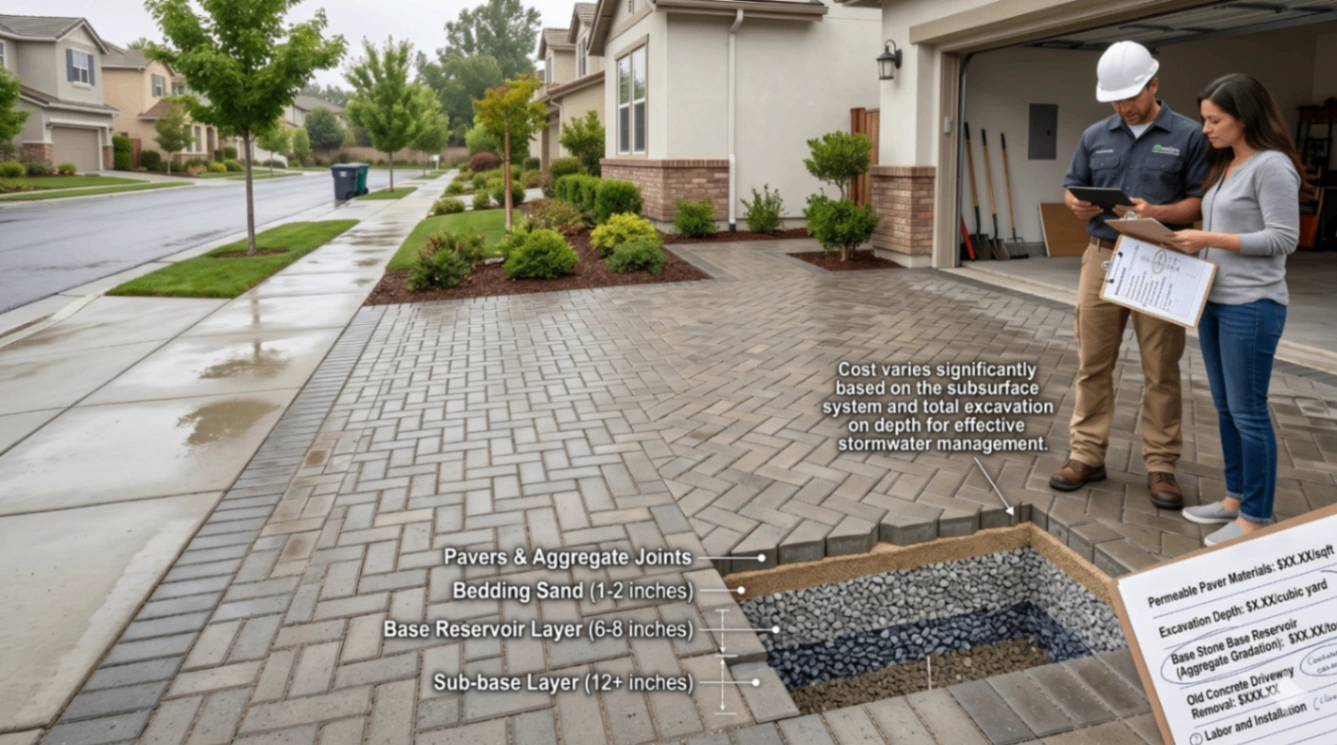
Phase 1: Site preparation and excavation
Installation begins with excavating existing ground to depths that accommodate the aggregate base and paver surface. Key details for this phase:
- Excavation depth typically ranges from 12–24 inches for driveways
- Soil testing is often included to determine infiltration rate
- Infiltration results shape the design of everything below the surface
Phase 2: Base layer and aggregate reservoir
This is the most important (and often most expensive) part of the installation. The aggregate base acts as both a structural foundation and a temporary storage reservoir for rainwater.
- Base material: Typically crushed stone
- Depth: Determined by the soil’s absorption capacity and the stormwater volume the system needs to manage
- Cost impact: Deeper reservoirs mean more stone and more labor
Phase 3: Laying the pavers and finishing
The final phase brings the surface together. Here’s what it involves:
- Placing a bedding layer of smaller stone beneath the pavers
- Setting pavers precisely, with PICP requiring more careful hand-setting than poured surfaces
- Filling joints with permeable aggregate (not sand, which would clog the system)
- Installing edge restraints to keep pavers from shifting over time
Ask your contractor to itemize each phase so you can see exactly where your money goes.
Permeable pavers vs. traditional concrete and asphalt: cost comparison
Permeable pavers cost more to install than standard concrete or asphalt. That’s the straightforward comparison. But the full picture includes what happens after installation, and that’s when the cost comparison changes.
Conventional impervious surfaces often require separate stormwater infrastructure: retention ponds, drainage systems, or larger pipes. Those costs may fall on developments, municipalities, or property owners through stormwater fees or utility charges. Permeable pavers absorb that drainage function into the surface itself.
| Surface type | Installed cost (per sq ft) | Stormwater management | Lifespan | Maintenance |
| Permeable pavers | $8–$30+ | Built-in | 20–30 years | Annual vacuuming |
| Standard concrete | $4–$8 | Separate system needed | 25–50 years | Sealing every 2–5 years |
| Porous asphalt | $3–$7 | Built-in | 15–20 years | Periodic resealing |
When stormwater utility rebates and incentives factor in, the effective cost gap between permeable and conventional surfaces often narrows. Rainplan helps property owners identify exactly which rebates apply to their address before committing to a project, so you can compare net costs rather than sticker prices alone.
Permeable paver maintenance and lifespan costs
Permeable pavers require routine maintenance to perform well over time. Upkeep is straightforward and predictable. Here’s what to plan for:
- Annual vacuum sweeping: Removes sediment that can clog joints; may be needed more often in areas with heavy leaf fall or construction dust
- Joint aggregate top-ups: Every few years as material settles or washes out
- Individual paver replacement: Damaged units can be lifted and swapped out — a practical advantage over poured concrete, which requires patching or full-section replacement
With proper maintenance, permeable interlocking concrete pavers typically last 20–30 years. That lifespan makes the higher upfront cost easier to justify when you spread it across decades of use.
7 ways to reduce your permeable paver installation cost
You have more control over project costs than you might think. These strategies help you manage your budget without sacrificing quality, covering material selection, timing, and financing.
1. Apply for stormwater rebates and incentives before you start
Many municipalities, utilities, and state programs offer rebates specifically for permeable pavers, sometimes covering $10–$20 per square foot of installed cost. Some programs require pre-approval before work begins. Search your address on Rainplan to find what incentives are available at your property before getting contractor quotes.
2. Choose the right material for your use case
Not every project needs PICP. For utilitarian side yards or overflow parking areas, plastic grid pavers may perform just as well at a fraction of the cost. Matching material to function (rather than defaulting to premium options) is one of the most direct ways to manage your budget.
3. Keep the design simple
Intricate patterns, curves, and multiple paver colors increase labor time and material waste. Straightforward running bond or grid patterns in single colors install faster and are easier to source.
4. Bundle with other green infrastructure projects
If you’re also planning rain gardens, downspout disconnection, or other stormwater improvements, bundling projects with a single contractor can reduce mobilization costs and may qualify you for larger combined rebates.
5. Get at least 3 contractor quotes
Permeable paver installation is a specialized skill, and pricing varies widely between contractors. Getting multiple quotes helps you identify whether bids are itemized correctly — with base layer, excavation, materials, and labor shown as separate line items.
6. Time your project for the off-season
Contractors in many regions are less busy in late fall and winter, which can translate to lower labor rates or faster scheduling. If your timeline is flexible, avoid peak spring and summer installation windows.
7. Use financing to preserve cash flow
Some programs, including Rainplan, pay approved project costs upfront so you’re not out of pocket while waiting for rebate reimbursements.
Do permeable pavers increase property value?
Permeable pavers can add to a property’s perceived value, particularly in areas with active stormwater regulations, frequent flooding, or environmentally conscious buyers. That added value doesn’t always show up in formal appraisals the way kitchen renovations do.
The more tangible financial benefit is often a reduction in stormwater utility fees. Some municipalities charge property owners based on the amount of impervious surface on their lot — replacing that surface with permeable pavers can reduce or eliminate those fees entirely.
Where to find rebates and financing for permeable pavers
Rebates and incentive programs for permeable pavers are available at local, state, and federal levels, but they vary significantly by location. Many property owners simply don’t know what’s available at their address. Knowing your options before starting a project can meaningfully reduce your actual out-of-pocket costs.
Here are the main program types to explore:
- Municipal stormwater rebates: Many cities and counties offer per-square-foot rebates for permeable paving as part of stormwater management programs
- Utility-based incentive programs: Some water utilities offer credits or rebates to property owners who reduce runoff from their lots
- State green infrastructure grants: Several states have grant programs for residential green infrastructure, particularly in areas with combined sewer overflow challenges
- Federal tax incentives: In some cases, green infrastructure improvements on commercial or rental properties may qualify for depreciation or energy-efficiency-related deductions — consult a tax advisor for guidance
Rainplan’s platform analyzes your property’s impervious surfaces and runoff profile, then surfaces the specific incentives and rebates available at your address. You’ll know what you qualify for before committing to a project. Search your address on Rainplan to see what’s available in your area.
Make your permeable paver investment work harder
Permeable pavers cost more upfront than conventional paving, but the range is wide. With the right material choices, well-timed projects, and available incentives, the effective cost is often more manageable than the sticker price.
Rebates can meaningfully change the math. Knowing your options before you request contractor quotes puts you in a stronger position to evaluate bids, plan your budget, and avoid overpaying for work that incentive programs could partially cover.
The best first step is finding out what’s available at your specific address. Enter your address on Rainplan to see available stormwater incentives and connect with vetted permeable paver installers in your area.
Frequently asked questions
How long do permeable pavers last?
Permeable interlocking concrete pavers typically last 20–30 years with routine maintenance. Individual pavers can be replaced without disturbing the full surface, which extends the practical lifespan of the system.
Are permeable pavers worth the cost compared to regular concrete?
Permeable pavers cost more to install than standard concrete, but they eliminate the need for separate stormwater drainage infrastructure and can reduce stormwater utility fees. When you factor in total ownership costs, the gap between permeable and conventional surfaces is often smaller than the upfront prices indicate.
Can permeable pavers handle heavy vehicles like trucks or RVs?
Permeable interlocking concrete pavers and pervious concrete can be engineered to handle heavy loads when the base layer is designed for that purpose. Plastic grid pavers vary by product, so check the manufacturer’s load ratings before specifying them for heavy vehicle use.
Do permeable pavers get clogged over time?
Permeable pavers can lose infiltration capacity if sediment accumulates in the joints, but annual vacuum sweeping prevents this in most residential applications. Systems installed in areas with heavy clay soil or nearby construction activity may need more frequent maintenance.
What is the difference between permeable pavers and pervious concrete?
Permeable pavers are individual units — typically concrete or plastic — set over an aggregate base, while pervious concrete is a poured surface with a porous matrix. Both allow water infiltration, but permeable pavers are easier to repair because individual units can be lifted and replaced without disturbing the surrounding surface.
Do any government programs help pay for permeable pavers?
Many municipalities, water utilities, and state agencies offer rebates or grants for permeable paving as part of stormwater management programs. Availability and amounts vary by location. Rainplan’s platform surfaces the specific programs available at your property address, so you know exactly what you qualify for before starting your project.
Find Rainwater Rebates in Your Area
Enter your address to see local rebates for rain barrels and green infrastructure. Many programs cover 50%+ of costs.